How to Track AI Brand Mentions: 5 Concrete Steps
AI brand mention tracking in 5 concrete steps — build query set, define personas, dispatch matrix, parse, compute. Build vs buy decision matrix.
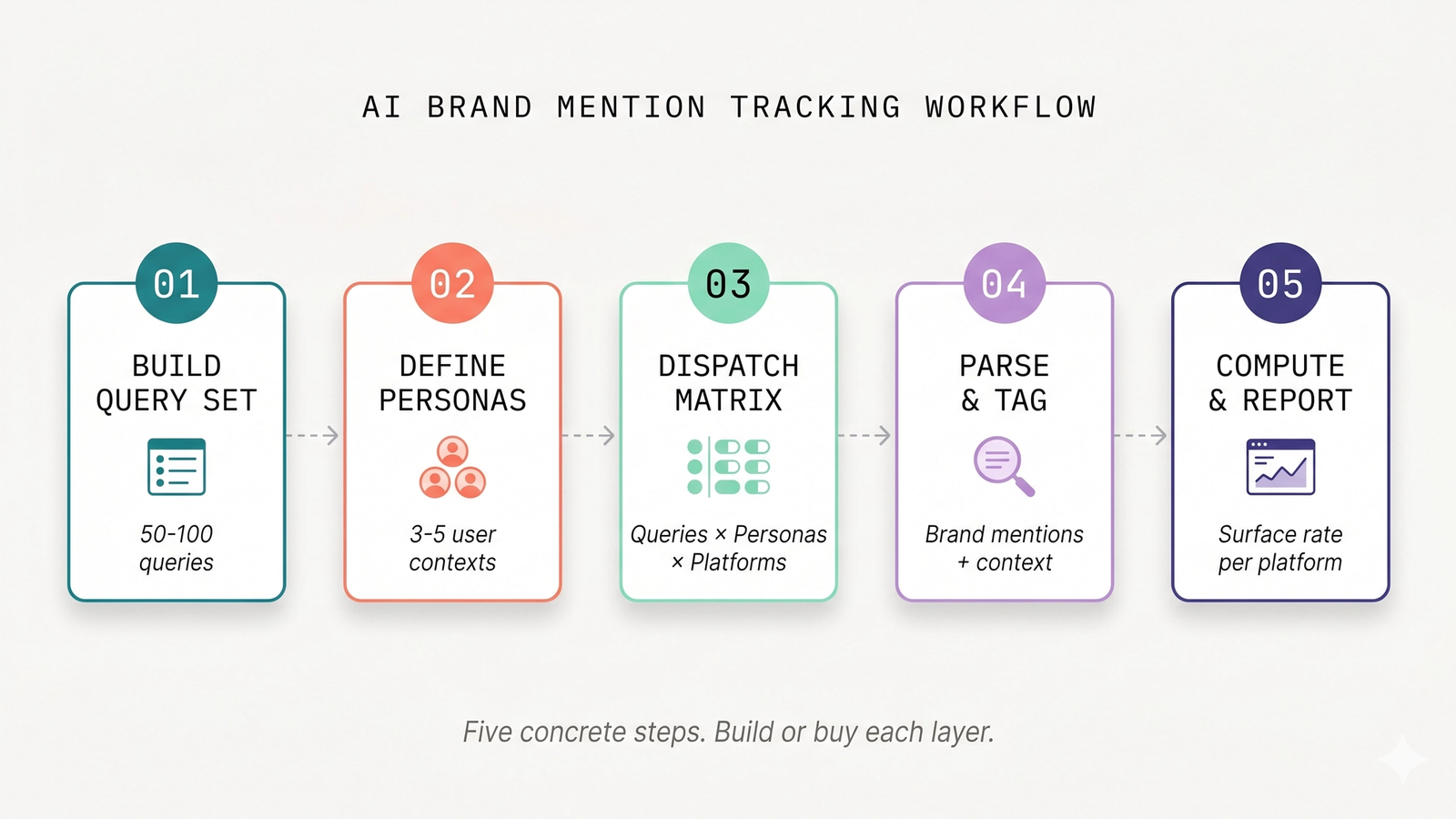
AI brand mention tracking sounds complex. It's not. The work breaks down into five concrete steps that any team can execute — though most teams either over-engineer the problem (build a six-month internal platform) or under-build it (run ad hoc ChatGPT screenshots and call it measurement).
This guide is the operational walkthrough between those extremes. What to do on Monday morning, in five steps, with the decision points for build-vs-buy at each layer. The full conceptual framework is in How to Measure AI Search Visibility. This guide is the how-to.
The Five Concrete Steps
- Build your query set — 50-100 queries representative of your category
- Define your personas — 3-5 user contexts that capture audience variation
- Dispatch the matrix — queries × personas × platforms (4 of them)
- Parse and tag responses — extract brand mentions and citation context
- Compute and report — surface rate per platform with breakdowns
Each step has a build-or-buy decision and a "minimum viable" version you can ship in a week if you need to.
Step 1: Build Your Query Set
The biggest determinant of measurement quality is query selection. A query set that doesn't reflect what real buyers actually ask AI assistants produces measurement that doesn't reflect actual buyer behavior.
Where queries come from
Five sources, in priority order:
- Customer support tickets — questions buyers asked while evaluating you. These are the highest-fidelity AI query patterns because they reflect actual buyer voice.
- Sales call transcripts — the questions prospects asked during discovery calls.
- Customer interviews — explicit "what did you ask AI when you were considering us?" conversations.
- Search Console data — Google search queries that drive your category traffic. Translate these into conversational form.
- Competitor comparison content — what queries are your competitors targeting in their content? Your query set should overlap.
Query type mix
A useful query set spans four categories:
- Category queries ("What are the best [category] tools for [use case]?") — top of funnel
- Comparison queries ("Is [Brand A] or [Brand B] better for [use case]?") — mid-funnel
- Branded queries ("Does [Your brand] support [feature]?", "Is [Your brand] worth the price?") — bottom of funnel
- Recommendation queries ("Recommend a [category] for [specific situation]") — highest conversion intent
Sample size
50-150 queries per persona. Below 50, surface rate is noisy week-over-week. Above 150, additional queries don't meaningfully improve signal. Most B2B SaaS programs run 75-100 queries per persona.
Refresh cadence
Quarterly. Add new queries reflecting category evolution. Don't remove queries mid-cycle (it breaks trend continuity); retire them in scheduled refresh windows.
Common mistake
Using SEO keywords directly. SEO keywords are typically short ("CRM software") and optimized for Google rank. AI conversational queries are longer and more natural ("what's the best CRM for a 50-person fintech in Bangalore?"). Translating SEO keywords into conversational form is required.
Step 2: Define Your Personas
The same query produces different AI responses for different user personas. A query asked "as a CTO at a 50-person fintech" returns different brands than the same query asked "as a CMO at the same company." Personas capture this variance.
Persona context blob
A persona is a 50-80 word context block prepended to each query during dispatch. A useful persona blob includes:
- Role and seniority — "CMO at a 50-person B2B SaaS company"
- Geography — "based in Bangalore, India"
- Industry / use case — "targeting mid-market enterprise buyers in fintech"
- Sophistication level — "comfortable with technical product discussions"
- Known constraints — "evaluating tools that integrate with HubSpot"
How many personas
3-5 per category for B2B; 3-4 for D2C; 1-3 for narrow local services.
For B2B SaaS, persona variation along buyer-role lines (CEO, CMO, CTO, end-user, agency-buyer) reveals the most actionable variance. For D2C, buyer-context variation (price-sensitive vs premium vs gift buyer) matters more. For local services, geography is the dominant variable.
Common mistake
Too few personas misses variance. In one B2B audit we ran, the brand showed 38% surface rate under a CTO persona and 4% under a CMO persona. Aggregated, the program would have averaged these (~21%) and missed the structural insight that the brand was invisible to economic buyers.
Too many personas dilutes statistical signal. Each persona's slice gets smaller; insights become harder to extract. Stay in the 3-5 range unless you have specific reason to expand.
Step 3: Dispatch the Matrix
Your dispatch volume is a multiplication problem.
- Platforms — Variable: P · Typical value: 4 (AIO, ChatGPT, Gemini, Perplexity)
- Personas — Variable: N · Typical value: 3-5
- Queries — Variable: M · Typical value: 50-150 per persona
- Total dispatches per cycle — Variable: P × N × M · Typical value: 600-3,000
For a typical B2B SaaS measurement program: 4 × 5 × 100 = 2,000 dispatches per cycle. For a D2C consumer brand with 3 personas and 75 queries: 4 × 3 × 75 = 900 dispatches per cycle.
Dispatching the right way
- Real query dispatch, not proxy signals. Send actual queries. Do not infer AI visibility from organic Google rank or backlink profile.
- Geo-seeding for AIO and ChatGPT. Both are geo-aware. Set your dispatch origin to the geographies you care about (Bangalore vs Mumbai vs Delhi for India-anchored brands; multiple cities for US national brands).
- Persona prepending consistent. Every dispatch includes the persona context blob. Same persona across re-runs.
- Platform-specific implementation. Different platforms need different dispatch approaches:
- AIO: browser-based capture (Playwright) — Google's APIs do not return AIO content
- ChatGPT: API or browser-driven session
- Gemini: API or browser-driven session
- Perplexity: API (most directly programmable)
- Anti-bot mitigation. AI platforms detect bot traffic. Use realistic dispatch patterns, varied IP addresses where appropriate, and respect rate limits.
Why this is infeasible to do manually
A human running 2,000 queries through chat interfaces, copying responses, tagging mentions, takes weeks per cycle and produces inconsistent data. Even at 100-query scale, manual dispatch is a 1-2 day commitment per cycle. The choice is automation or sparse measurement.
Step 4: Parse and Tag Responses
Each AI platform returns a different output format. Your parser has to handle each one.
Brand mention extraction
Entity recognition tuned to your tracked brand list. Extract every mention of your brand and named competitors from each response.
Edge cases:
- Pronoun resolution. AI responses sometimes name a brand once then refer to it as "it" later. Naive parsers miss the second mention. Better parsers track conversational context.
- Brand-name disambiguation. If your brand name is a common noun ("Apple" the company vs the fruit), parsers need disambiguation logic.
- Misspellings and aliases. Buyers and AI sometimes mis-type or use abbreviations. Your parser should normalize ("Notion" vs "Notion AI" vs "@notion") to a single brand entity.
Citation context classification
Beyond binary "mentioned vs not mentioned," tag each mention with context:
- Recommended — the brand is offered as the answer
- Compared favorably — in a comparison, brand wins on the primary criterion
- Compared neutrally — comparison without preference
- Compared negatively — positioned as worse than alternative
- Mentioned as alternative — listed in "other options" clause
- Passing reference — named without contextual evaluation
- Quoted as authority — cited as a source for a fact
Source URL capture
For Perplexity especially, capture the cited source URLs. This enables routable-layer attribution — you can verify the source went to your site (or competitor's), and perplexity.ai referrers in your analytics validate the citation produced traffic.
Validation cadence
Periodic spot-check audits. Take a sample of 50 dispatches per platform per cycle and manually verify whether brand mentions were correctly extracted and citation context correctly classified. Aim for >95% accuracy. Below 95%, parser improvements are higher-leverage than additional dispatch volume.
Step 5: Compute and Report
The output of measurement is decision-supporting reports. Three breakdowns matter most.
Surface rate per platform
Surface rate = (dispatches where brand is cited) / (total dispatches) × 100Reported per platform — never as a single aggregate. The per-platform asymmetry is the actionable signal.
Per-persona breakdown
For each platform, surface rate broken down by persona. Reveals whether your visibility is even across audience segments or concentrated in one buyer profile.
Per-query-type breakdown
Surface rate by category / comparison / branded / recommendation queries. Reveals funnel weaknesses. A brand strong on branded queries and weak on category queries has a top-of-funnel discovery problem.
Citation context distribution
What share of citations were "recommended" vs "compared favorably" vs "passing reference"? Citation context shapes buyer impact more than citation count.
Competitor benchmarks
Run the identical query set, persona set, and platform matrix for 3-5 named competitors. Compute their surface rates with the same methodology. Compare per-platform.
Without competitor data, your number is uninterpretable. A 12% surface rate is excellent or catastrophic depending on whether competitors hit 5% or 60%.
Time-series tracking
Monthly minimum cadence. Quarterly for slow-moving categories. Track surface rate movement over time alongside the optimization actions taken — this is how you attribute lift to specific interventions.
Build vs Buy — The Practical Decision Matrix
The five-step pipeline can be built in-house or sourced from a vendor. Each layer has different build-vs-buy economics.
Build path
Total time: 3-6 months of dedicated engineering effort. Ongoing maintenance: serial commitment for platform UI changes, parser updates, new platform additions.
Costs include:
- Engineer time to build dispatch infrastructure across 4 platforms
- Persona orchestration system
- Platform-specific parsers with citation context extraction
- Geo-seeded dispatch infrastructure
- Time-series storage with drift detection
- Competitor benchmarking automation
- Internal dashboards
Makes sense when: dedicated engineering capacity is available; agency volume justifies the build (typically 50+ clients on monitoring); deep customization is required for unusual category needs.
Buy path
Time to deploy: weeks. Ongoing maintenance: vendor handles infrastructure, you handle interpretation.
Trade-offs: less customization, vendor relationship, recurring SaaS cost.
Makes sense when: engineering opportunity cost is high; volume is below 50 clients; standard methodology meets your needs.
Hybrid path
Buy the dispatch + parsing layer; build internal dashboards on top of the vendor data. Common pattern for mid-sized agencies and in-house teams that want full control of reporting but don't want to build dispatch infrastructure.
Decision factors
- Engineering capacity — Build favors: Available · Buy favors: Constrained
- Scale — Build favors: 50+ clients on monitoring · Buy favors: Below 50 clients
- Customization — Build favors: Deep customization required · Buy favors: Standard methodology fits
- Time to first measurement — Build favors: 3-6 months acceptable · Buy favors: Weeks needed
- Total cost focus — Build favors: Long-term cost optimization · Buy favors: Time-to-value optimization
- Maintenance posture — Build favors: Engineering team owns · Buy favors: Vendor team owns
For most teams in 2026, the buy or hybrid paths produce better unit economics than full in-house build. The build path makes sense for specific scale and customization scenarios; otherwise vendor or hybrid is faster and cheaper to operate.
Frequently Asked Questions
Can I track AI brand mentions manually?
For a one-time baseline audit at small scale (50 queries × 1 persona × 4 platforms = 200 dispatches), yes. Plan a full day of work. For ongoing monthly measurement at meaningful scale (2,000+ dispatches per cycle), no — manual dispatch is a 1-2 week commitment per cycle and produces inconsistent data. Automation is required for sustained programs.
How accurate does my parser need to be?
Aim for >95% accuracy on brand mention extraction and citation context classification. Below 95%, the noise overwhelms the signal — surface rate movements you observe may be parser drift, not actual change. Above 98%, the marginal accuracy gain produces diminishing returns relative to engineering effort.
How often should I re-run the audit?
Monthly minimum for active GEO programs. Quarterly for slow-moving categories without active optimization. Weekly for fast-moving categories (consumer, news-adjacent) or during active product launches. Continuous monitoring (daily snapshots + weekly full audits) for category leaders defending share.
What's the most expensive part of building this in-house?
Per-platform parsers with edge case handling. Pronoun resolution, alias normalization, citation context classification, platform UI change adaptation — these compound over time as platforms evolve. Most teams that build in-house underestimate this layer by 2-3x.
How do I track ChatGPT specifically?
ChatGPT's web search returns conversational text with optional source links. Capture via API or browser-driven session. Parse the response text for brand mentions with entity recognition. Capture source links separately. Account for ChatGPT Memory contamination by dispatching from clean contexts (no logged-in user, no prior conversation history). (See How ChatGPT Decides What to Recommend for the full mechanism.)
Should I track all four platforms or focus on one?
For most brands, all four. Each has different audience characteristics. Single-platform measurement misses the per-platform asymmetry that determines optimization priority. Single-platform measurement can be defensible for very narrow audiences (Perplexity-only for some technical B2B) but is rare.
How long does it take to set up a measurement program from scratch?
Buy or hybrid path: 1-2 weeks from decision to first results. Build path: 3-6 months. Either way, the first 30 days after dispatch start are baseline establishment — meaningful month-over-month comparison requires 2-3 cycles.
Run Your AI Search Audit
Citare automates the full five-step pipeline — query dispatch across all four AI platforms with persona context, parsing with citation context classification, surface rate computation with per-platform and per-persona breakdowns, and competitor benchmarking — so your team focuses on interpretation and action, not infrastructure.
Run your free AI visibility audit → [citare.ai/audit]